
History
Obtain a history of hypertension and/or preeclampsia in previous pregnancies. Document any coexisting medical conditions that may increase the risk of hypertension, such as diabetes mellitus (DM), renal disease, or autoimmune disorders. Assess for associated symptoms including nausea or vomiting, malaise, headache, visual disturbances, sudden-onset edema, chest pain, dyspnea, and changes in urine output.
Physical Examination
Prenatal Checkup
Clinical BP Measurement
 Hypertension in Pregnancy_Initial Assesment 1
The patient should be seated quietly for at least 5 minutes in a chair with feet on the floor and arm supported at heart level prior to measurement of the BP (or in the left lateral recumbent position during labor). An appropriately sized cuff should be placed at heart level of the patient and should not be placed over any clothing. Use the appearance of phase I Korotkoff sounds for systolic BP and the disappearance of phase V for diastolic BP to determine the BP. The differences in BP between two arms should be noted, and the arm with the consistently higher measurement should be used for all subsequent BP readings. Make sure devices to be used are professionally validated specifically in pregnancy and preeclampsia.
Diagnosis or Diagnostic Criteria
Preeclampsia/Eclampsia
Preeclampsia or eclampsia always presents potential danger to the mother and baby; therefore, prevention relies on identifying high-risk women. Offer hospital admission to the patient if there are clinical concerns and for close clinical and lab monitoring aimed at early recognition and institution of treatment or delivery when indicated.
Subclassification of Preeclampsia
- Early-onset: With delivery at <34+0 weeks of gestation
- Preterm: With delivery at <37+0 weeks of gestation
- Late-onset: With delivery at ≥34+0 weeks of gestation
- Term: With delivery at ≥37+0 weeks of gestation
Diagnostic Criteria of Preeclampsia
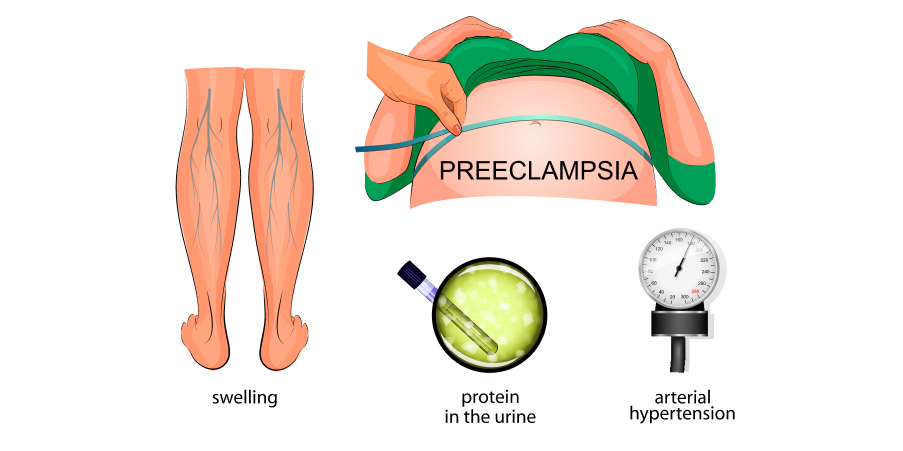 Hypertension in Pregnancy_Initial Assesment 2
- Hypertension after 20 weeks of gestation with proteinuria OR
- New-onset hypertension with new onset of any of the following, even in the
absence of proteinuria:
- Thrombocytopenia
- Elevated levels of liver transaminases to twice the normal concentration
- New-onset headache unresponsive to medication and not explained by other causes, or visual symptoms
- Renal insufficiency
- Pulmonary edema
Findings that Support the Diagnosis of Severe Preeclampsia
One or more of the following:
- SBP ≥160 mmHg and/or DBP ≥110 mmHg on two occasions at least 4 hours apart during bed rest
- Severe persistent epigastric or right upper quadrant pain unresponsive to medications
- New-onset or persistent headache or other cerebral or visual disturbances
- Pulmonary edema and/or congestive heart failure
- Platelet <100,000 cells/mm3 or microangiopathic hemolytic anemia (with increased lactic acid dehydrogenase)
- Elevated liver enzymes (AST or ALT) ≥2x the upper limit of normal value
- HELLP syndrome (hemolysis, elevated liver enzymes, low platelet count)
- Severe proteinuria and oliguria <500 mL/day
- Serum creatinine >1.1 mg/dL or increased to twice the normal concentration without other renal disease
Preeclampsia Superimposed on Chronic Hypertension
Preeclampsia superimposed on chronic hypertension is also called pre-existing hypertension plus superimposed gestational hypertension with proteinuria. The diagnosis is based on lab tests as above and should be used to distinguish between superimposed preeclampsia and worsening chronic hypertension. This refers to patients having pre-existing hypertension or chronic hypertension with any of the following:
- New-onset proteinuria (≥3 g/24 hr) presents at >20 weeks of gestation
- Proteinuria in <20 weeks of gestation that is worsening
- Sudden increase in the BP that was previously well-controlled
- Thrombocytopenia
- Elevated liver enzymes
- Appearance of preeclampsia/eclampsia features
Atypical Preeclampsia
Atypical preeclampsia has early signs and symptoms of preeclampsia-eclampsia occurring at <20 weeks of gestation. This may also be a late postpartum preeclampsia-eclampsia occurring >48 hours after delivery.
Gestational hypertension is diagnosed with the presence of ≥1 of the following: Preeclampsia symptoms; hemolysis; elevated liver enzymes (AST or ALT) 2x the upper limit of normal value; and thrombocytopenia <100,000/mm3.
Gestational proteinuria is diagnosed with the presence of ≥1 of the following: Preeclampsia symptoms; hemolysis; elevated liver enzymes; and thrombocytopenia.
Preterm Preeclampsia
Screen all pregnant women in the first trimester for preterm preeclampsia using the following: Maternal characteristics (eg advanced maternal age, obesity, South Asian ethnicity, smoking history, family history of preeclampsia), obstetrical history (nulliparity, history of preeclampsia, short and long interval between pregnancies, gestational age at delivery and birth weight of prior pregnancy >24 weeks, contraceptive method, or use of assisted reproductive technologies) and medical history (eg chronic hypertension, DM, renal disease, SLE, antiphospholipid syndrome); mean arterial pressure (MAP); uterine artery pulsatility index; and placental growth factor (PlGF). The baseline test in low-resource settings or by primary care should include maternal risk factors and MAP.