
Clinical Presentation
PARKINSON’S DISEASE
Symptoms
Early symptoms of Parkinson’s disease are subtle and occur gradually.
Motor Signs and Symptoms
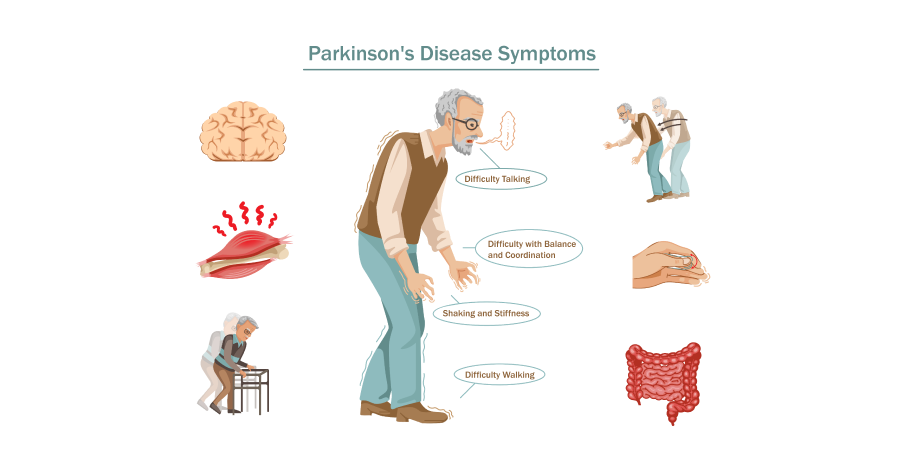 Parkinsons Disease and Dementia_Disease Initial Assesment 1
Motor signs and symptoms include resting tremor, rigidity, bradykinesia, and postural instability.
Nonmotor Signs and Symptoms
Nonmotor signs and symptoms include autonomic disturbances (eg gastrointestinal dysfunction, urinary and sexual dysfunction, orthostatic hypotension, hyperhidrosis), sleep disorders (eg impaired sleep initiation and maintenance, rapid eye movement sleep behavior disorder, and excessive daytime sleepiness), sensory disturbances (eg pain, hyposmia, and visual dysfunction), and neuropsychiatric symptoms (eg depression, anxiety and panic attacks, dementia, and psychosis).
PARKINSON’S DISEASE DEMENTIA (PDD)
Parkinson’s disease patients showing mild cognitive impairment should be assessed. Parkinson’s disease dementia may present with bradyphrenia and memory retrieval deficits; impaired set shifting and maintenance; impaired problem solving; poor visuospatial function; decreased fluency and other language abnormalities; and mood disorders are often noted. Patients with Parkinson’s disease presenting with dementia and depression have more severe disabilities and develop a faster decline in cognitive function. Faster rates of cognitive impairment and poor prognosis are commonly noted in Parkinson’s disease patients with older age, hallucinations, and the non-tremor motor subtype. Atypical neurological features of parkinsonism (eg early occurrence of autonomic failure, symmetrical disease presentation, non-tremor presentation, poor response to dopamine agonists) are indicative of other neurodegenerative diseases associated with more severe dementia.
Diagnosis or Diagnostic Criteria
DIAGNOSIS OF PARKINSON’S DISEASE
 Parkinsons Disease and Dementia_Disease Initial Assesment 2
It may be difficult to diagnose Parkinson’s disease during the early stages of the disease.
The diagnosis of Parkinson’s disease is clinical and requires the presence of the cardinal manifestations of Parkinson’s disease, absence of atypical features, a slowly progressive course, and a response to drug therapy. Pronounced loss of olfactory sense can distinguish Parkinson’s disease from other forms of parkinsonism.
Clinical Diagnostic Criteria for Parkinson’s Disease Based on the Movement Disorder Society (MDS)
The clinical diagnostic criteria for Parkinson’s disease require the essential characteristic of Parkinson’s disease, which is the presence of motor parkinsonism (bradykinesia with at least one of rest tremor or rigidity). The examination of all cardinal manifestations of Parkinson’s disease should be performed according to instructions in the MDS-Unified Parkinson Disease Rating Scale (MDS-UPDRS). To determine that the cause of motor parkinsonism is Parkinson’s disease, it is essential to have the presence of supportive criteria to counterbalance the presence of any “red flags” and requires the absence of absolute exclusion criteria.
Please see Differential Diagnosis discussion for the red flags and absolute exclusion criteria.
A clinically established Parkinson’s disease can be made if all of the following requirements are met:
- Positive parkinsonism
- No absolute exclusion criteria (see Differential Diagnosis discussion)
- At least two supportive criteria
- No red flags (see Differential Diagnosis discussion)
DIAGNOSIS OF PARKINSON’S DISEASE DEMENTIA
Based on DSM-5-TR diagnostic criteria, a diagnosis of
major or mild neurocognitive disorder probably due
to Parkinson’s disease can be made if the first two
criteria are met:
- The criteria are met for major or mild neurocognitive disorder
- The disturbance occurs in the context of established Parkinson’s disease
- There are insidious onset and gradual progression of cognitive impairment
- The neurocognitive disorder is not attributable to another medical condition and is not better explained by another mental disorder
Based
on the Movement Disorder Society clinical diagnostic criteria for Parkinson’s
disease dementia, the core features are:
- A confirmed diagnosis of Parkinson’s disease according to Queen Square Brain Bank criteria
- Dementia that develops slowly and progressively after the onset of established Parkinson’s disease and is diagnosed by history, clinical and mental examination, and defined as: Impairment in more than one cognitive domain; cognitive decline from previous functioning level; and cognitive deficits severe enough to affect daily activities (ie social, occupational or personal care), independent from the impairment caused by motor or autonomic symptoms
The clinical distinction between Parkinson’s disease dementia and dementia with Lewy bodies lies in the timing of the onset of cognitive impairment in relation to motor symptoms: Parkinson’s disease dementia >1 year; and dementia with Lewy bodies ≤1 year.
Screening
Screening Tools for Dementia
The Montreal Cognitive Assessment (MoCA) has been found to be a more accurate bedside test for Parkinson’s disease dementia. The Mini-Mental State Examination (MMSE) and the Cambridge Cognitive Examination (CAMCog) are the other screening tools for dementia.