
Laboratory Tests and Ancillaries
Diagnostic Studies
First trimester screening for bacteriuria in pregnant women is recommended. Pregnant women may be screened for asymptomatic bacteriuria with a urine culture and treated with the shortest effective course of therapy (2-7 days). Screening for and treating asymptomatic bacteriuria are recommended prior to urological procedures breaching the mucosa but are not recommended in the following: Women with no risk factors, postmenopausal women, elderly institutionalized patients, patients prior to arthroplasty or cardiovascular surgeries, patients with well-controlled diabetes mellitus (DM), dysfunctional and/or reconstructed lower urinary tracts, renal transplants, or recurrent UTIs. The diagnostic criteria for acute cystitis and pyelonephritis for healthy pregnant women are the same as for non-pregnant women. Extensive workup is not done in women <40 years old with recurrent UTI and no risk factors.
Urinalysis
Urinalysis is recommended for routine diagnosis of pyelonephritis in premenopausal, non-pregnant women. This includes assessment of white blood cells (WBC), red blood cells, and nitrites, and a result showing ≥10 WBC/mm3 suggests urinary tract infection.
Urine Dipstick
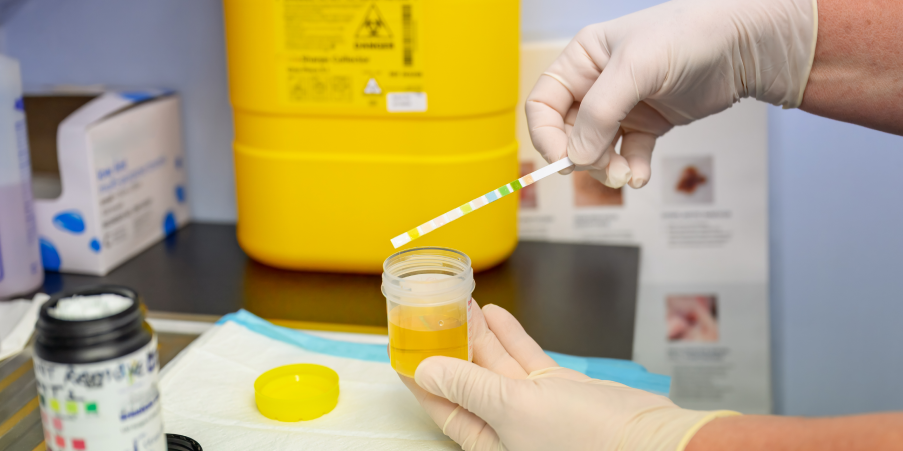 Urinary Tract Infection - Uncomplicated_Diagnostics 1
A urine dipstick is an alternative to urine culture for diagnosis of acute uncomplicated cystitis. This is a rapid and inexpensive method to check for leukocyte esterase or nitrite. A positive nitrite usually indicates an infection (Enterobacteriaceae converts nitrate to nitrite) with 19-48% sensitivity and 92-100% specificity. The presence of leukocyte esterase (produced by neutrophils), indicating pyuria associated with a urinary tract infection, has 72-97% sensitivity and 41-86% specificity. A urine dipstick is considered a good screening test, but false-negative results are common. This may help guide treatment decisions for healthy women <65 years of age that present with mild or ≤2 symptoms of urinary tract infection.
Urine Culture
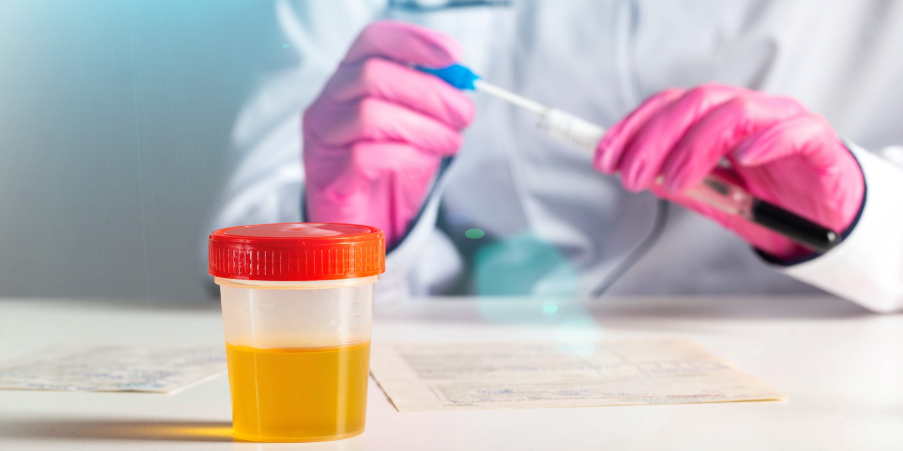 Urinary Tract Infection - Uncomplicated_Diagnostics 2
A urine culture is used to identify the causative agent and its sensitivity to antibiotics. The culture of bladder urine obtained by suprapubic needle aspiration is the gold standard method to diagnose bacteriuria. This has minimal risk for urine specimen contamination. This is recommended in patients with suspected systemic UTI, symptoms that do not resolve within 48 hours of antibiotic use, symptoms recurring within 4 weeks after the completion of treatment, and those who are pregnant, at high risk for infection with antimicrobial-resistant pathogens, or present with atypical symptoms. Urine culture should also be done in symptomatic pregnant patients before empiric antibiotic treatment is started and 7 days after completion of treatment as a test of cure. This helps tailor treatment in patients given empiric therapy or those with initial treatment failure and may also be used to diagnose recurrent UTI.
Significant results from a midstream urine specimen include growth of ≥103 colony-forming units (cfu)/mL in patients with acute cystitis, recurrent UTI, symptomatic pregnant women, and growth of ≥104 cfu/mL in acute uncomplicated pyelonephritis; growth of ≥105 cfu/mL in two consecutive samples in women and in one single sample in men confirms asymptomatic bacteriuria. The growth of bacteria in any count is relevant in a specimen obtained from suprapubic bladder puncture.
A urine culture is not for routine use in patients presenting symptoms of acute uncomplicated cystitis. A midstream urine culture and sensitivity should be done in patients with recurrent UTI during the first presentation of their symptoms to establish a correct diagnosis. A >100,000 cfu/high-power field (HPF) is considered culture-positive for urinary tract infection, but a result showing >1,000 cfu/HPF is enough to document infection in a symptomatic woman.
Imaging
Additional diagnostic studies should be considered in patients with atypical symptoms, patients who fail to respond to appropriate antibiotics, and women with infections secondary to Proteus sp, Pseudomonas sp, Enterobacter sp or Klebsiella sp due to the possibility of structural abnormalities. An ultrasound of the upper urinary tract may be done to rule out urinary tract obstruction or renal stones. In pregnant women, kidney and urinary tract ultrasound is needed if pyelonephritis is suspected. Blood culture and sensitivity, helical computed tomography (CT) scan, excretory urography, or dimercaptosuccinic acid scanning may be performed in patients who are still febrile after 72 hours of treatment or with suspected complications such as sepsis.
Antimicrobial susceptibility testing should be performed in women treated for acute uncomplicated cystitis whose symptoms do not resolve after treatment and in all cases of pyelonephritis. Imaging of the urinary tract to exclude urgent urological disorders is recommended as part of the diagnostic evaluation for pyelonephritis.