Dual glucagon/GLP-1 RA survodutide shows broad benefits in phase III obesity & MASLD trials
a day ago
Survodutide, a glucagon receptor– glucagon-like peptide-1 (GLP-1) receptor dual agonist, significantly reduces body weight and liver/visceral fat in individuals with obesity as well as those with obesity and at-risk metabolic dysfunction–associated steatotic liver disease (MASLD) in the phase III SYNCHRONIZE-1 and SYNCHRONIZE-MASLD trials. The data, presented at ADA 2026, also demonstrate improvements in cardiometabolic parameters indicating broad benefits associated with survodutide treatment.
Up to 16.6 percent weight loss in 76-week obesity trial
In the SYNCHRONIZE-1 trial involving patients with obesity without diabetes, survodutide at both the 3.6 mg and 6.0 mg doses demonstrated significantly greater weight loss vs placebo at 76 weeks. [N Engl J Med 2026;doi:10.1056/NEJMoa2600751]
“[The results showed that] survodutide is an effective treatment for obesity, with sustained weight reductions of up to 16.6 percent. Body weight reduction with survodutide was driven predominantly by loss of fat tissue,” said lead author Professor Carel le Roux observed of University College Dublin School of Medicine, Dublin, Ireland, and Ulster University, Coleraine, UK. [le Roux C, et al, ADA 2026]
The trial included 725 adults with BMI ≥30 kg/m2, or BMI ≥27 kg/m2 with ≥1 obesity-related complication excluding diabetes (mean age, 47.1 years; mean BMI, 37.9 kg/m2; male, 40.6 percent; Asian, 22.3 percent). Almost 70 percent of participants had ≥1 obesity-related complication – most commonly hypertension (40.1 percent), followed by dyslipidaemia (33.9 percent) and obstructive sleep apnoea (18.3 percent).
The participants were randomized 1:1:1 to receive survodutide up to 3.6 mg QW (n=241) or up to 6.0 mg QW (n=242) or placebo (n=242), in addition to lifestyle modification comprising a reduced-calorie diet (deficit of approximately 500 kcal/day relative to estimated total daily energy expenditure) and moderate-intensity exercise (≥150 minutes/week). A flexible dose-escalation scheme was in place for survodutide to mitigate gastrointestinal (GI) side effects.
The trial met its dual primary endpoints of percentage change in body weight and ≥5 percent reduction in body weight from baseline at 76 weeks.
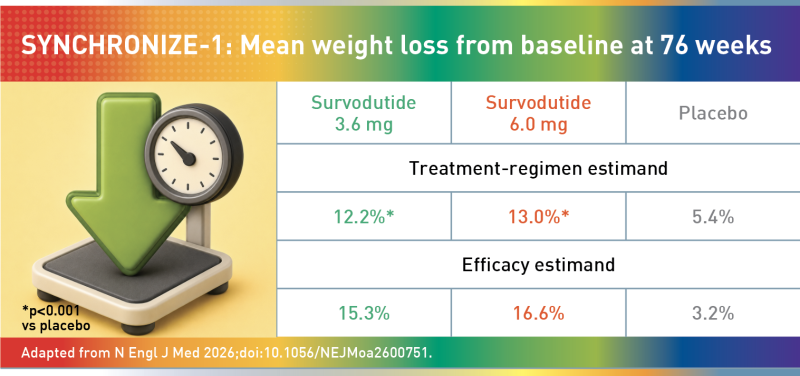
At 76 weeks, mean change in body weight from baseline by treatment-regimen estimand was -12.2 percent with survodutide 3.6 mg, -13.0 percent with survodutide 6.0 mg, and -5.4 percent with placebo (both p<0.001). The mean absolute change in body weight was -13.1, -14.1 and -5.9 kg, respectively.
Weight loss by efficacy estimand at 76 weeks was 15.3, 16.6 and 3.2 percent, respectively.
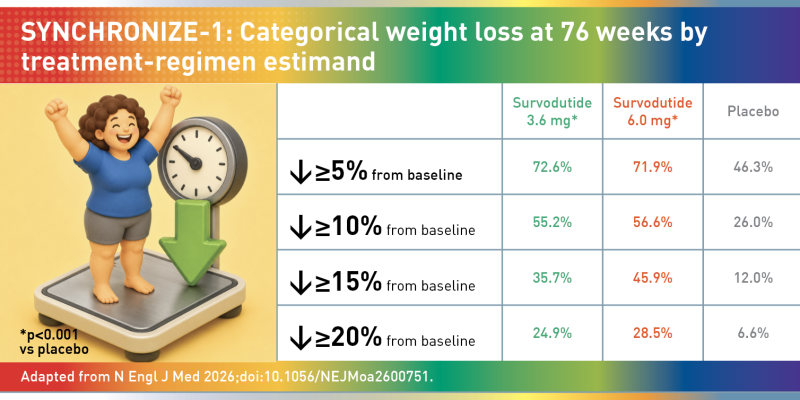
Weight reduction of ≥5 percent at 76 weeks was achieved by 72.6, 71.9 and 46.3 percent of participants in the survodutide 3.6 mg, survodutide 6.0 mg and placebo groups, respectively (treatment-regimen estimand; both p<0.001). Significantly more patients treated with survodutide 3.6 mg and 6.0 mg vs placebo achieved greater categorical weight loss of ≥10 percent (55.2 and 56.6 percent, respectively, vs 26.0 percent), ≥15 percent (35.7 and 45.9 percent vs 12.0 percent), or ≥20 percent (24.9 and 28.5 percent vs 6.6 percent) at 76 weeks (all p<0.001).
Visceral fat loss, cardiometabolic risk factor improvements
The significant weight loss observed with survodutide in SYNCHRONIZE-1 was accompanied by reduction in visceral (including liver) fat and improvements in cardiometabolic risk factors. [N Engl J Med 2026;doi:10.1056/NEJMoa2600751; le Roux C, et al, ADA 2026]
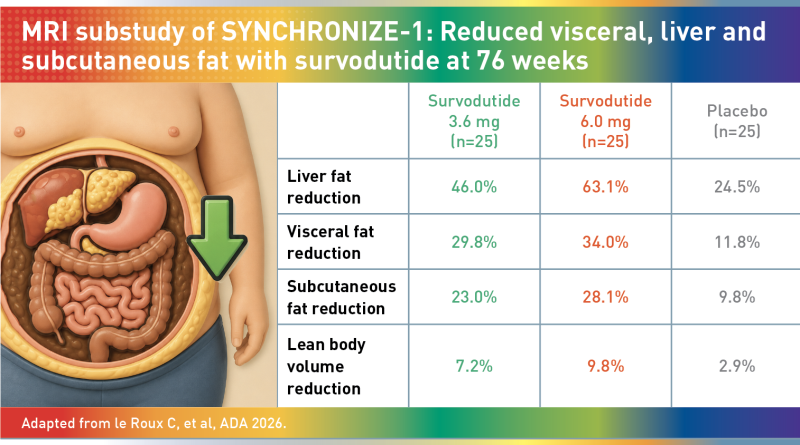
In a body composition substudy involving a subgroup of participants who underwent MRI (survodutide 3.6 mg, n=25; survodutide 6.0 mg, n=25; placebo, n=25), survodutide was associated with reductions in visceral, liver and subcutaneous fat as well as improvement in body composition at 76 weeks. “Lean body volume decreased by only [up to] 9.8 percent,” pointed out le Roux.
MRI-based lean loss ratio (ie, lean body mass change divided by total tissue mass change) was 11.1 and 10.8 with survodutide 3.6 mg and 6.0 mg, respectively, compared with 12.8 with placebo, suggesting that survodutide is associated with preferential fat reduction.
“The 14.6 cm reduction in waist circumference [with survodutide 6.0 mg] is impressive not only because of the metabolic impact, but also because this represents at least six notches on a belt. This is driving improved functionality in our patients,” highlighted le Roux.
Improvements in other cardiometabolic parameters, including blood pressure (BP), glycaemic control, insulin resistance and lipid profile, were also observed with survodutide. Among participants with prediabetes (survodutide 3.6 mg, n=38; survodutide 6.0 mg, n=43; placebo, n=50), none in the survodutide groups progressed to type 2 diabetes (T2D). In the placebo group, three patients progressed to T2D. “More importantly, we can now turn the clock back by effectively treating these patients [with prediabetes] and revert them to normoglycaemia. This is incredibly empowering,” said le Roux.
Regression to normoglycaemia occurred in 30 and 32 patients with prediabetes in the survodutide 3.6 mg and 6.0 mg groups, respectively, compared with 10 in the placebo group.
“The data demonstrate broad benefits of survodutide in improving metabolic health,” said le Roux. “We need to move our thinking and our patients’ thinking to the health gains that are really important to them. These health gains are meaningful not only to our patients, but also to the payers.”
MASLD trial: Reduced steatosis & body weight at 48 weeks
In the SYNCHRONIZE-MASLD trial involving patients with obesity and at-risk MASLD, survodutide demonstrated significant reductions in liver fat content, body weight, and markers of liver injury, inflammation and fibrosis vs placebo. [Nat Med 2026;doi:10.1038/s41591-026-04479-3]
The trial included 216 adults with obesity (same definition as in SYNCHRONIZE-1) and MASLD with evidence of liver inflammation and/or fibrosis by noninvasive tests or biopsy-confirmed metabolic dysfunction–associated steatohepatitis (MASH) (mean age, 55.8 years; mean BMI, 39.6 kg/m2, male, 39.4 percent; mean MRI proton density fat fraction [MRI-PDFF]–assessed liver fat content, 16.9 percent). Most participants (94.4 percent) had ≥1 extrahepatic metabolic complication, including T2D (38.4 percent).
Randomization was 2:1 to 48 weeks of treatment with survodutide 6.0 mg QW (including a 24-week dose-escalation period and a 24-week dose maintenance period) (n=146) or placebo (n=70). All participants also received the same counselling on diet and exercise as in SYNCHRONIZE-1.
The trial met its coprimary endpoints of ≥30 percent reduction in MRI-PDFF–assessed liver fat content and change in body weight from baseline at 48 weeks.
In the survodutide group, 84.2 percent of patients had ≥30 percent reduction in liver fat content by efficacy estimand, vs 24.3 percent in the placebo group (p<0.0001). Adjusted mean relative reduction in liver fat content at 48 weeks was 58.7 vs 9.5 percent.
Greater reductions in liver fat content of ≥50 percent and ≥70 percent were also achieved by significantly more patients in the survodutide vs placebo group (efficacy estimand: 75.3 vs 8.6 percent and 55.5 vs 2.9 percent, respectively; p<0.0001).
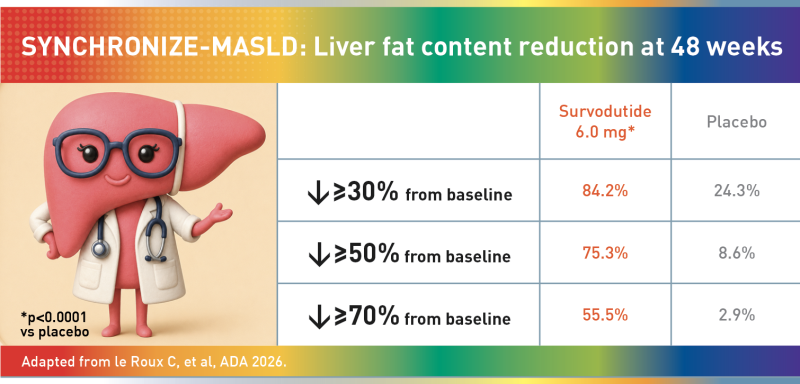
“A 30 percent decrease in liver fat has been shown in several studies to predict a substantial improvement in MASH,” said lead author Dr Lee Kaplan of Obesity and Metabolism Institute, Boston, Massachusetts & Geisel School of Medicine at Dartmouth, Hanover, New Hampshire, US. “A 50 percent loss of liver fat has been associated with improvement not only in MASH, but also in fibrosis, and a 70 percent loss has been associated with complete normalization of liver fat content.”
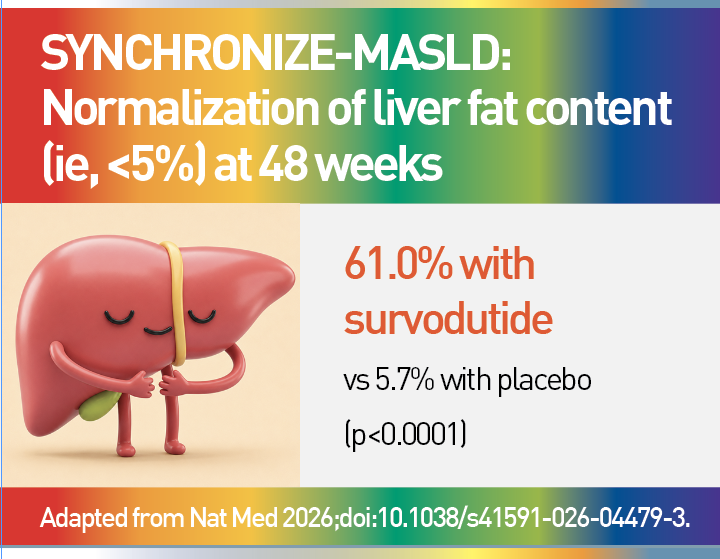
Notably, 61.0 percent of survodutide-treated patients achieved normalization of liver fat content (ie, <5 percent), compared with 5.7 percent in the placebo group (efficacy estimand; p<0.0001).
Improved markers of liver injury, inflammation & fibrosis
Treatment with survodutide was associated with significant improvements in alanine aminotransferase (ALT), aspartate aminotransferase (AST) and iron-corrected T1 (cT1; a measure of liver fibroinflammatory activity) vs placebo. [Nat Med 2026;doi:10.1038/ s41591-026-04479-3]
“A 20 percent decrease in transaminases – regardless of baseline level – is the best predictor of MASH improvement,” said Kaplan. “At 48 weeks, ALT decreased by 36.8 percent in the survodutide group vs 11.0 percent in the placebo group [p=0.0002]. Among 39 participants with elevated ALT at baseline, ALT normalization was achieved in 82.1 vs 27.3 percent.”
Significantly greater reductions in AST (27.9 vs 7.2 percent; p=0.0006) and cT1 (116.8 vs 23.9 ms; p<0.0001) were also observed with survodutide vs placebo. Noninvasive tests for liver stiffness (vibration-controlled transient elastography) and fibrogenic activity (enhanced liver fibrosis score) also improved significantly with survodutide vs placebo.
Improved cardiometabolic parameters in MASLD
At week 48, waist circumference decreased by 11.1 vs 1.9 cm in the survodutide vs placebo group (p<0.0001), insulin resistance improved by 46.3 vs 12.4 percent (p=0.0007), and high-sensitivity C-reactive protein decreased by 46.2 vs 7.2 percent (p=0.0003).
Significantly greater reductions with survodutide were also observed in BP (between-group difference, -7.4/-2.7 mm Hg [p=0.0003 for systolic BP and p=0.0478 for diastolic BP]), HbA1c (between-group difference, -0.6 percent; p<0.0001), and lipid levels.
No new safety signals in both trials
In both trials, survodutide demonstrated a safety profile that was consistent with other therapies with GLP-1 receptor agonist (RA) activity, with no safety findings attributable to glucagon receptor agonism. Adverse events (AEs) were mostly mild-to-moderate GI symptoms – predominantly nausea, vomiting, diarrhoea and constipation – which occurred mainly during the dose-escalation period. [N Engl J Med 2026;doi:10.1056/NEJMoa2600751; le Roux C, et al, ADA 2026; Nat Med 2026;doi:10.1038/s41591-026-04479-3; Kaplan L, et al, ADA 2026]
AEs led to treatment discontinuation in 23.7, 24.8 and 5.4 percent of participants in the survodutide 3.6 mg, survodutide 6.0 mg and placebo groups of SYNCHRONIZE-1, respectively. In SYNCHRONIZE-MASLD, these occurred in 23.3 vs 10.0 percent of those in the survodutide 6.0 mg vs placebo group.