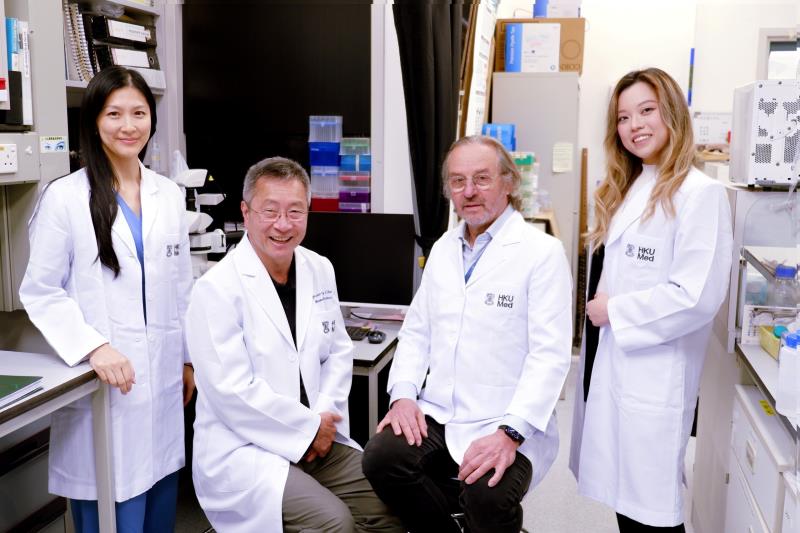
Researchers from the University of Hong Kong (HKU), in collaboration with the Lunenfeld-Tanenbaum Research Institute at Sinai Health in Toronto, Canada, have genetically engineered human stem cells that can ‘cloak’ themselves to evade immune rejection while carrying a built-in kill-switch to prevent tumour formation, supporting potential application of safe, off-the-shelf therapeutic cells generated in vitro for transplantation in stem cell–based regenerative therapies.
Utilizing a humanized immune system mouse model, the team successfully generated allogeneic tissues from SafeCell-AlloAccept (SC-AlloAccept) cells in immunocompetent humanized mice in the highly immune-active subcutaneous region. [Stem Cell Reports 2026;doi:10.1016/j.stemcr.2026.102850]
“We have demonstrated three desired properties of ‘SC-AlloAccept’, a new class of genome-edited human embryonic stem cells [H1],” said Professor Danny Chan of the School of Biomedical Sciences, HKU, who is co-leader of the research team. “The progeny of these cells can avoid immune rejection, address the shortage of suitable donor cells, and reduce the risk of transplanted cells turning cancerous.”
“Crucially, the cells did not compromise normal immune function. Mice remained fully capable of rejecting ordinary foreign cells, ensuring protection against infections and cancer,” added co-leader, Professor Andras Nagy of Lunenfeld-Tanenbaum Research Institute, Sinai Health, Toronto, Canada. “In addition, the growth of immune-evasive cells could be halted by ganciclovir, the prodrug of the SC kill switch, further ensuring safety against potential tumour formation.”
Notably, SC-AlloAccept–derived grafts survived for 5 months, underscoring their potential for long-term engraftment. Importantly, neither prior rejection of immunogenic parental H1 cells (sensitization) nor the presence of immune-evasive H1-derived tissue (potentially immunocompromizing) affected the immune response to a subsequent second transplant.
“Efficacy suggests that it can provide a cure; safety ensures the patient lives to receive it. For universal cell therapies, safety is not just a requirement – it is the very foundation of future advances,” said Professor Pengtao Liu of the School of Biomedical Sciences, HKU, and Managing Director of the InnoHK Centre for Translational Stem Cell Biology.
Pluripotent stem cells (PSCs) are capable of producing many functional cell types for therapy, but their successful engraftment requires human leukocyte antigen (HLA) compatibility, or systemic immunosuppression to prevent graft rejection. Besides genome editing by manipulating the major histocompatibility complex (MHC)/HLA genes, donor cells can be engineered without altering the MHC/HLA genes to express immune‑modulating transgenes that “cloak” them from allogeneic rejection by inhibition of innate and adaptive immune responses, including those mediated by dendritic cells, T cells, NK cells, and macrophages. Such immune‑evasive cells could enable universal cell therapies, but they also bypass immune surveillance, making an inducible genetic kill-switch targeting rogue cells essential for safety. [Cell Stem Cell 2020;27:198-199; Nat Biomed Eng 2024;8:427-442; Nat Rev Bioeng 2024;2:960-979]
The research team believes that this breakthrough in regenerative medicine will help overcome major barriers in transplantation, such as long donor waiting lists and the need for lifelong immunosuppressive therapies, which carry clinical risks such as nephrotoxicity and opportunistic infections.
“This is a major step in realizing the dream of having a potential universal, off-the-shelf product for cell therapy,” noted Chan. “While our findings are still at the preclinical stage, they point to a future where patients could receive safe, ready-to-use cell therapies. This advance could reshape treatment approaches for numerous diseases and lay a strong foundation for future clinical testing.”