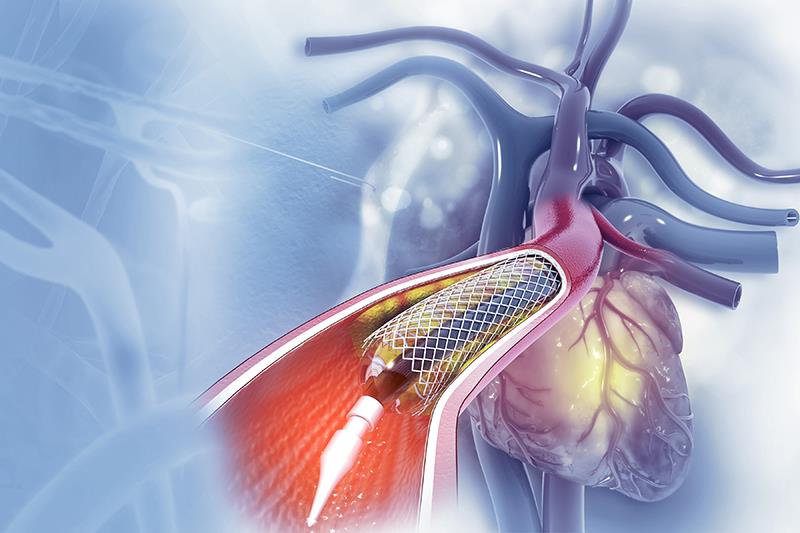
The 3-year results from the SIRONA trial demonstrate the superiority of a sirolimus-coated balloon (SCB) over a paclitaxel-coated balloon (PCB) in terms of freedom from clinically driven target lesion revascularization (TLR) in patients with symptomatic femoropopliteal artery disease.
At 36 months, 88.2 percent of participants in the SCB group achieved freedom from TLR, compared with 80.2 percent in the PCB group. A comparison between groups yielded a hazard ratio (HR) of 0.60 (95 percent confidence interval [CI], 0.36–0.97) and a log-rank p-value of 0.03, which was statistically significant. [Teichgräber, U, et al, CX 2026]
The between-group difference was greater than that reported at 1 year (95.6 percent vs 93.1 percent) and at 2 years (91.2 percent vs 88.1 percent).
However, there were no differences between SCB and PCB in terms of freedom from major amputation (99.6 percent for both; HR, 0.54, 95 percent CI, 0.04–5.96; log-rank p=0.61), freedom from all-cause mortality (92.6 percent for both; HR, 1.12, 95 percent CI, 0.59–2.27; log-rank p=0.67), and self-assessed pain-free walking distance (1,784 vs 1,611 m; p=0.47) at 3 years.
An alternative to PCBs
Evidence has shown an association between PCBs and increased mortality. [J Am Heart Assoc 2018;7:e011245; J Soc Cardiovasc Angiogr Interv 2023;2:100981] Sirolimus trumps paclitaxel due to its anti-inflammatory and anti-restenotic effects, and broader therapeutic range. [CVIR Endovasc 2022;5:29; JACC Cardiovasc Interv 2019;12:558-566]
“Sirolimus is antiproliferative, cytostatic, and immunosuppressive,” noted Prof Ulf Teichgräber from the Friedrich-Schiller-University Jena, Germany, at the Charing Cross (CX) International Symposium 2026.
Teichgräber and colleagues conducted this investigator-initiated, head-to-head trial in 482 patients (mean age 68 years, 64.5 percent men) from 25 centres in Germany and Austria. Ninety-six percent of participants presented with intermittent claudication. The participants were randomized 1:1 to either SCB or PCB angioplasty of the femoropopliteal segment. Seventy-eight percent of participants completed the 3-year follow-up.
In the SCB group, the device used was the MagicTouch® PTA SCB. Sirolimus was encapsulated in phospholipid drug carrier submicron particles at a dose of 1.27 µg/mm2. In the PCB group, the most common device used was the Luminor 35™ (35 percent), followed by Lutonix™ (20 percent).
Overall, the mean lesion length was 84 mm, and about 16 percent of participants had long lesions (≥15 cm). One-third of the overall population had chronic total occlusions, nearly three-quarters were classified as Category 3 (ie, severe claudication) in the Rutherford-Becker classification, 46 percent had a Peripheral Arterial Calcium Scoring System score of 3, and 26 percent had >1 drug-coated balloon.
The current findings augment the interim results demonstrating the noninferiority of SCB to PCB for femoropopliteal primary patency at 12 months. [Trials 2021;22:665; J Am Coll Cardiol 2026:S0735-1097(25)10433-6]
SIRONA is the first large-scale, head-to-head randomized controlled trial comparing SCBs against PCBs in patients with femoropopliteal artery disease. The long-term clinical outcomes confirm the sustained and superior treatment efficacy of SCB over PCB, suggesting that SCBs may be a valuable alternative to PCBs, noted Teichgräber and colleagues.