
Laboratory Tests and Ancillaries
Work-up for Chronic Hypertension
Evaluate patients with pre-existing hypertension before pregnancy to define its severity and to facilitate planning for changes in lifestyle and pharmacotherapy if required. If a woman’s BP elevation is confirmed, and especially if it is severe, a woman should be evaluated for potentially reversible causes. Women with a history of high BP for several years should be evaluated for target organ damage.
 Hypertension in Pregnancy_Diagnostics 1
Lab tests should be taken, if not yet done previously or recently, to exclude secondary causes, risk factors, and target organ damage. Complete blood count (CBC), platelet count, urinalysis, renal function test, fasting blood sugar, lipid profile (after a 9- to 12-hour fast), serum Na, K, uric acid, and liver enzymes should be done.
Presence of Secondary Cause or Evidence of Target Organ Damage (TOD)
Patients should be referred to a specialist and treated appropriately if a secondary cause of hypertension is found. Further tests should be done, if TOD is found, in order to evaluate the level of severity.
Further Assessment
It is important to rule out preeclampsia in pregnant women with hypertension. The following are used to distinguish preeclampsia from chronic hypertension: CBC, platelet count, urinalysis, blood smear, coagulation profile, serum creatinine, uric acid, liver enzymes, serum albumin, lactic acid dehydrogenase, and oxygen saturation.
All pregnant women should be checked for proteinuria in early pregnancy to identify pre-existing renal disease and in the second half of pregnancy to screen for preeclampsia. A 24-hour urine collection is recommended, but other acceptable methods are the urine dipstick test or the urine protein/creatinine ratio. Proteinuria should be suspected in patients with ≥1+ protein on a urine dipstick and followed up with a urine protein/creatinine ratio in a single spot urine sample. Confirmation of proteinuria includes: ≥300 mg in a 24-hour urine sample, ≥30 mg/mmol protein/creatinine ratio in a random or spot urine sample, and albumin/creatinine ratio ≥8 mg/mmol or ≥2+ protein on a urine dipstick.
Other diagnostic work-ups that may be considered in patients at risk of developing preeclampsia include fetal ultrasound for fetal growth and amniotic fluid volume assessment, ultrasound of the adrenals, plasma and urinary fractionated metanephrine assays, Doppler ultrasound of the uterine arteries after 20 weeks of gestation, and measurement of soluble fms-like tyrosine kinase-1 (sFlt-1)/placental growth factor (PlGF) ratio (angiogenic markers). PlGF-based testing may be done between 20-36 weeks of pregnancy to exclude preeclampsia in women with chronic hypertension suspected of developing preeclampsia. Angiogenic imbalance (eg reduced PlGF [<5th centile for gestational age] or increased sFlt-1/PlGF ratio [>38]) suggests uteroplacental dysfunction. An sFlt-1/PIGF ≥85 or PlGF <12 pg/mL confirms preeclampsia.
Imaging
Work-up for Chronic Hypertension
 Hypertension in Pregnancy_Diagnostics 2
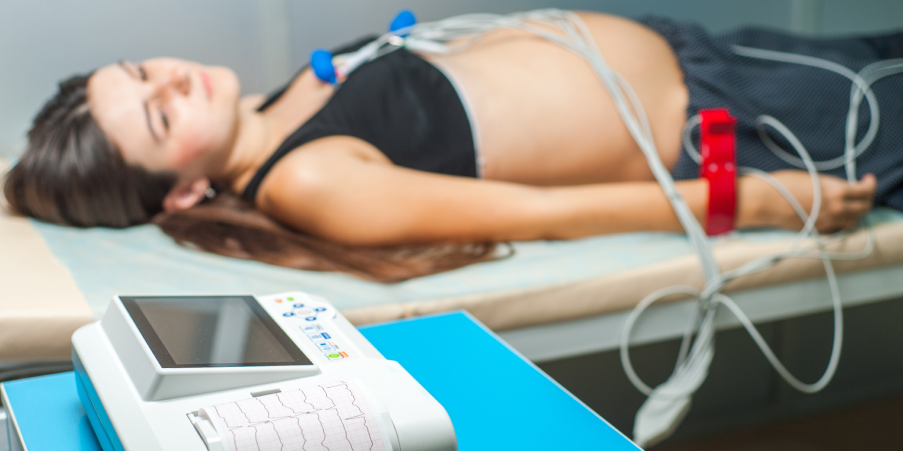
To assess chronic hypertension, a chest X-ray and 12-lead electrocardiogram (ECG) may be done.