A structured, physiotherapist-led six-session exercise programme provides sustained symptomatic and functional improvements to patients with end-stage knee osteoarthritis (OA) awaiting total knee replacement (TKR), a large real-world study in Hong Kong has shown.
The retrospective cohort study, conducted by researchers from Prince of Wales Hospital and Chinese University of Hong Kong, included 2,243 patients (mean age, 68.4 years; female, 71.2 percent; mean BMI, 26.1 kg/m2) with end-stage knee OA awaiting TKR in Hong Kong’s public hospitals between October 2021 and March 2024. [Clin Rheumatol 2026;doi:10.1007/s10067-026-08235-3]
The patients were recruited into the Structured Nonoperative Treatment Programme (SNTP) comprising six physiotherapist-led, supervised group exercise and education sessions (10–12 patients per group) delivered over a 1-year intervention period.
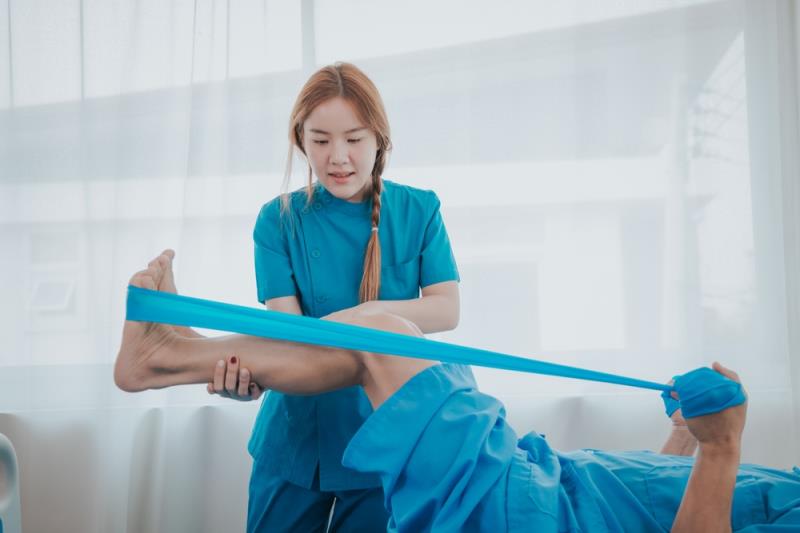
“All sessions included aerobic, strengthening and neuromuscular exercises, as well as health education to promote lifestyle modification and home exercise adherence,” the researchers explained. “Strengthening exercises targeted gluteus maximus, quadriceps, hamstrings, hip flexors, hip abductors and calf muscles using body weight, resistance bands and free weights at moderate intensity, progressing as tolerated and safe. Patients without contraindications also completed four sessions of hydrotherapy and, if appropriate, 10 minutes of whole-body vibration with mini squats.”
Improvements in symptoms & function
Patient-reported pain (primary outcome) significantly improved at final-session assessment (mean change in Numeric Pain Rating Scale [NPRS] from baseline, -0.9; p<0.001), with improvement sustained through 2-year follow-up (p<0.001).
Self-reported knee function (primary outcome; by Knee Injury and OA Outcome Score [KOOS]) improved significantly across the knee pain, knee quality, symptoms, activities of daily living, and sports domains following the programme (all p<0.001). “During follow-ups within 1–1.5 years, several KOOS subscales demonstrated significant improvements, though attenuation was observed thereafter,” the researchers reported.
Functional performance, measured by 30-second Chair Stand Test (30CST), Timed Up and Go (TUG) test and Functional Reach Test (FRT), showed significant improvements following the programme (all p<0.001). Improvement in 30CST was sustained during 2-year follow-up. Gains in TUG and FRT were generally maintained through 1-year follow-up, but slightly attenuated by 1.5–2 years.
Consistent with disease progression in end-stage knee OA, physiotherapist-assessed knee stability, alignment and range of motion (by Knee Society Score [KSS]) as well as walking and stair climbing (by KSS Functional Subscale) declined over time.
More durable benefits in patients with poor knee function
“Patients with poor baseline knee function [KSS ≤66; n=1,362] achieved the most sustained benefits – specifically up to 1.5 years,” the researchers pointed out. “The six group sessions resulted in significant improvements in pain, KOOS subscales, lower-limb function, and balance, with improvement in NPRS reaching clinically important difference.”
Among patients with fair (KSS, 67–76; n=461), good (KSS, 77–89; n=239), and excellent (KSS ≥90; n=181) knee function at baseline, improvements from the intervention were less pronounced and not sustained beyond 1 year. “[These patients may] require more progressive overload and individualized progression to see more sustained benefits,” the researchers suggested.
Scalable & cost-efficient programme
According to the researchers, the SNTP programme is scalable, cost-efficient and feasible across diverse healthcare settings. “Our findings support the programme as a bridging intervention that may relieve pain, preserve function, and mitigate deconditioning during the prolonged waiting time for TKR,” they suggested.