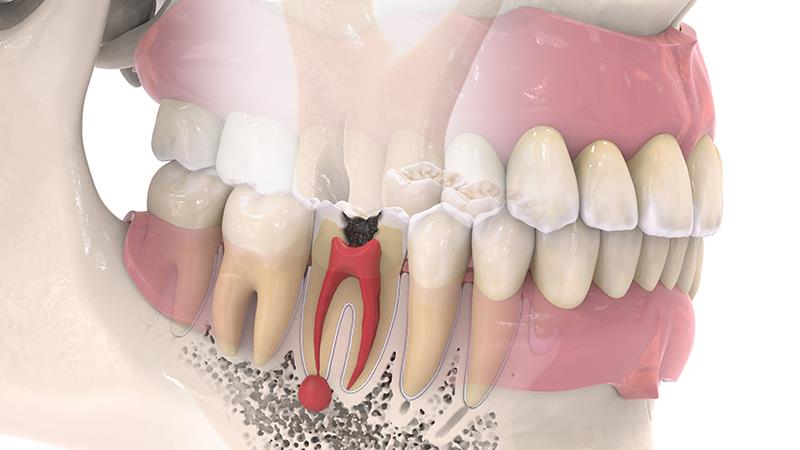
A study conducted by researchers at the National University of Singapore shows that a full pulpotomy is more effective than selective caries removal (SCR) for avoiding further intervention over 3 years in teeth with extensive caries, most of which were extremely deep lesions.
Overall, 79 percent (81.4 percent with multiple imputation) of teeth survived without requiring further intervention, such as root canal treatment (RCT) or extraction, over 3 years. The pulpotomy group had fewer teeth requiring further intervention than the SCR group, with (10.9 percent vs 25.9 percent; p=0.041) and without multiple imputation (10.8 percent vs 29.5 percent; p=0.039). [Int Endod J 2026;59:439-453]
As a result, the 3-year survival rates were higher with pulpotomy than SCR, with (89.1 percent vs 74.1 percent) and without multiple imputation (89.2 percent vs 70.5 percent).
The higher survival rate with pulpotomy vs SCR was evident in the subgroup analysis, but only for extremely deep lesions (p<0.05) and not for deep lesions (p>0.05).
The higher survival rate in the pulpotomy group was observed in the multivariate analysis (adjusted hazard ratio, 2.58). “[This indicates] that teeth treated with SCR were 2.58 times more likely to require RCT or extraction than those treated with full pulpotomy,” the investigators explained.
The higher failure rate with SCR may be due to its limitations in managing extremely deep lesions that penetrate the entire dentine thickness, which is associated with increased risk of bacterial penetration into tertiary dentine and more extensive pulpal inflammation. [Int Endod J 2019;52:949-973; Int Endod J 2021;54:319-330] “Such pulpal inflammation may not be resolved through selective excavation alone,” they said.
Moreover, clinically firm dentine can remain histologically infected with residual bacteria, which may contribute to delayed pulp breakdown and treatment failure despite a good marginal seal. [J Dent 2019;86:41-52]
The type of base may also have contributed to the lower failure rate in the pulpotomy group, in which calcium silicate-based liners—known to have superior biological and sealing properties—were used. [J Endod 2018;44:932-937; J Endod 2020;46:383-390]
Long-term efficacy unclear
SCR has demonstrated high success rates, but its long-term effectiveness is uncertain. Bacteria have been observed in both ‘leathery’ and hard carious dentine, and these may cause ongoing pulpal irritation and potential pulp necrosis when the seal fails. [J Dent 2016;54:25-32; J Dent 2020;100:103430]
Pulpotomy may offer higher short-term survival rates than SCR for extensive caries, but long-term clinical outcomes for deep and extremely deep caries remain unclear. [Int Endod J 2023;56:1459-1474]
A total of 101 patients were randomized to SCR or full pulpotomy, with 11 patients contributing more than one tooth. Fifty-eight teeth in the SCR group and 55 in the pulpotomy group completed treatment. At 3 years, 44 and 37 teeth, respectively, were reviewed.
Approximately three-quarters of lesions were classified as extremely deep, which were defined as lesions that penetrated the full dentine thickness, for which pulp exposure was considered unavoidable during operative treatment. [Int Endod J 2019;52:923-934]
“In this trial, where more than two-thirds of the cases involved extremely deep caries, full pulpotomy achieved higher success rates in avoiding RCT or extraction compared with SCR at 36 months,” the researchers said.
They called for further long-term studies and broader health economic evaluations to guide clinical decision-making and policy development.
“Future research can also explore the use of preference-based measures to support clearer economic guidance for clinical and policy decision-making. Incorporating patient-reported outcome measures would enhance the understanding of the impact on quality of life, further aligning evaluations with patient-centred care,” they said.