
Giới thiệu
 Urinary Tract Infection - Uncomplicated_Disease Background 1
Acute uncomplicated urinary tract infection (UTI) is one of the most common bacterial infections in adults that may involve the lower and/or upper urinary tract. This is common in non-pregnant women without functional or structural urinary tract abnormalities, renal disease, or comorbidities. Acute uncomplicated cystitis is a lower urinary tract infection limited to the bladder. Acute uncomplicated pyelonephritis is an infection that involves the upper urinary tract, which includes the renal parenchyma and pelvicaliceal system that usually has significant bacteriuria. Asymptomatic bacteriuria is the presence of bacteria in the urine, which causes no symptoms or illness (ie commensal colonization), but treatment may be beneficial prior to urological procedures and in pregnant women.
Recurrent UTI is characterized by 2 culture-proven episodes of uncomplicated and/or complicated UTI in the last 6 months or 3 episodes with positive cultures in the last 12 months in patients with no functional or structural urinary tract abnormalities. It is considered a relapse if UTI is caused by the same organism after adequate therapy was given and a reinfection if UTI is caused by an organism that was previously isolated after treatment with a negative intervening urine culture result or urinary tract infection caused by another pathogen. Reinfection is more common than relapse. Recurrences usually occur within the first 3 months after initial infection.
Dịch tễ học
Urinary tract infection (UTI) is among the most common bacterial infections, especially in women. Approximately 50% of women experience at least one urinary tract infection during their lifetime, and about 25% of those develop recurrent infections. Urinary tract infection prevalence increases with age, except for a notable peak among females aged 14–24 years. The highest rate of uncomplicated UTIs occurs in women aged 18–39 years, coinciding with peak sexual activity.
In 2019, over 20% of global urinary tract infection cases occurred in South Asia, Western Europe, and tropical Latin America. India, Brazil, and the United States reported the highest numbers of UTI cases.
Nguyên nhân
Approximately 70-95% of cases are caused by Escherichia coli and 5-15% are secondary to Staphylococcus saprophyticus but Enterobacteriaceae organisms or enterococci (Proteus mirabilis, Klebsiella sp) are occasionally isolated.
Sinh lý bệnh
 Urinary Tract Infection - Uncomplicated_Disease Background 2
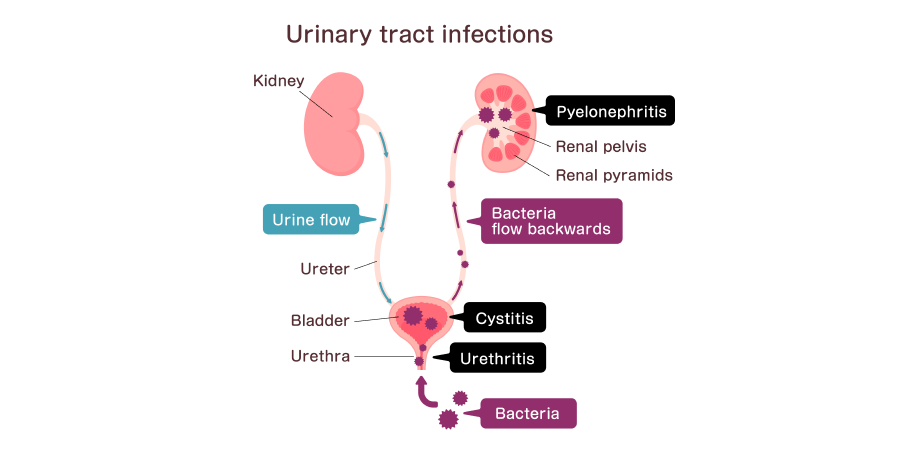
The most common route of urinary tract infection is the ascending spread of bacteria from the urethra to the bladder. These bacteria first colonize the periurethral area before entering the urinary tract, where they can multiply and travel up the ureters, potentially causing upper urinary tract infections such as pyelonephritis. Less commonly, upper UTIs develop through hematogenous spread, in which bacteria reach the kidneys via the bloodstream during prolonged bacteremia, often originating from deep-seated infections such as endocarditis.
Yếu tố nguy cơ
Risk factors for acute uncomplicated urinary tract infection (UTI) include anatomical factors such as the shorter urethra of females. Behavioral factors include sexual activity and delayed postcoital micturition. A new sexual partner and increased frequency of intercourse may increase the risk of recurrent UTI. The use of diaphragms and spermicides can promote colonization of the periurethral area with coliform bacteria and is a risk factor for recurrent UTI. Obstetric history, particularly increased parity, is also associated with increased risk.
Other risk factors include a history of recent UTI, urinary calculi, genitourinary instrumentation, surgery, and congenital defects. The risk of a second urinary tract infection within 6 months is higher when the first infection is caused by E coli. Previous antibiotic use and the presence of comorbidities such as diabetes mellitus (DM), obesity, sickle cell trait, and neurological disease, as well as being a geriatric or frail patient, further increase susceptibility.
Postmenopausal women are at increased risk for recurrent UTI due to decreased vaginal estrogen, vaginal atrophy, urinary incontinence, cystocele, rectocele, urethrocele, uterovaginal prolapse, incomplete bladder emptying, ABO blood group non-secretor status, a history of urinary tract infection before menopause, urine catheterization, and poor perineal hygiene in elderly institutionalized women. Resistant organisms are also a risk factor. Recurrent UTI may be common in patients who had their first episode of infection before 15 years of age and in those with a maternal history of urinary tract infection.
Phân loại
The 2025 European Association of Urology (EAU) guidelines revised its urinary tract infection (UTI) classification, moving away from the uncomplicated and complicated categories and instead emphasizing the distinction between localized and systemic UTI based on clinical signs and symptoms.
- Localized UTI (ie cystitis) is a cystitis with no signs and symptoms of systemic infection in either sex and is generally managed on an outpatient basis
- Systemic UTI (eg pyelonephritis, prostatitis) is an infection with signs and symptoms indicating systemic involvement with or without localized symptoms originating from any site in the urinary tract in either sex. This may require blood sampling, imaging, intravenous (IV) antimicrobial therapy, and hospitalization