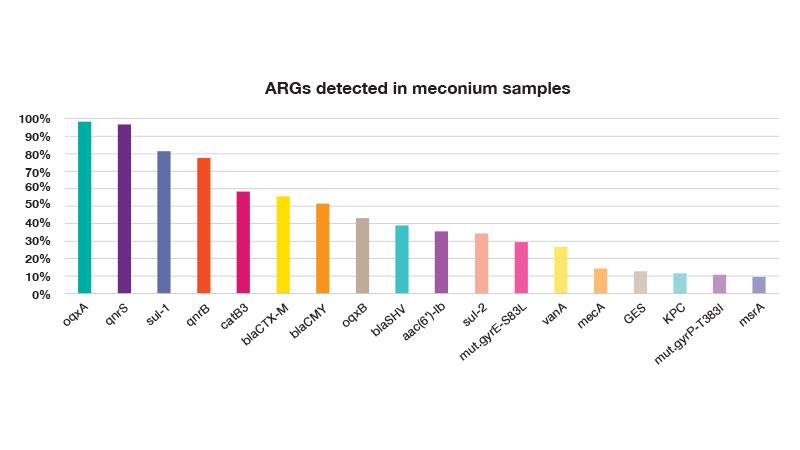
Antibiotic resistance genes (ARGs)—DNA segments that enable bacterial survival in the presence of antibiotics— can be detected in newborns’ meconium shortly after birth, as shown in a study presented at ESCMID Global 2026.
The most commonly detected genes were oqxA in 98 percent of samples and qnrS in 96 percent, both of which have been associated with resistance to commonly used antibiotics.
The study also identified several genes encoding beta-lactamases, enzymes that degrade widely used antibiotics. The most prevalent were blaCTXM (55 percent), blaCMY (51 percent), and blaSHV (39 percent). Genes associated with carbapenem resistance were present in 21 percent of the samples. Each sample had a median of eight resistance genes. [ESCMID Global 2026, abstract E0756]
“This finding suggests that a pattern of ARGs is already established at this stage. The neonatal gut harbours a diverse resistome, and the presence of clinically important ARGs early in life is concerning,” said lead author Dr Argyro Ftergioti from the Aristotle University of Thessaloniki, Greece. “Although some ARGs were expected, their high prevalence across most samples was striking – particularly for clinically critical genes offering carbapenem resistance.”
Early microbial exposure
Meconium, the first stool of newborns, was long thought to be sterile. [Microbiome 2017;5:48] However, microbial genetic material has been detected in meconium [Res Microbiol 2008;159:187-93], suggesting that the neonatal gut may be exposed to bacteria in utero. This early microbial exposure may contribute to antibiotic resistance.
Researchers thus screened meconium samples from 105 infants admitted to a neonatal intensive care unit within the first 72 hrs of life for 56 resistance genes associated with common antibiotics. Samples were collected between July 2024 and July 2025. The study was led by Professor Elias Iosifidis.
Associations were found between resistance genes and several maternal and neonatal factors. For example, the presence of the msrA (macrolide-streptogramin resistance) gene was linked to maternal hospitalization during pregnancy, whereas a greater number of resistance genes was associated with central venous catheter placement within the first 24 hrs of life. Both findings reflect exposure to healthcare-associated microbes in hospital settings.
Largest study of its kind
“This study is the largest of its kind examining how the hospital environment affects ARG collection in the neonatal gut,” said Ftergioti. “We analysed meconium samples within the first 72 hrs of life to capture the earliest snapshot of microbial and genetic exposure in newborns. At this stage, the collection of resistance genes is primarily shaped by maternal transmission, mode of delivery, and very early hospital exposures.”
Surprisingly, resuscitation shortly after birth was associated with fewer resistance genes. However, Ftergioti cautioned that the finding should be interpreted carefully, as it “may reflect differences in early microbial exposure or other clinical factors.”
Overall, the results indicate that both maternal transmission and early hospital exposure may contribute to the development of ARGs within the neonatal gut.
“While further research is needed to understand how early carriage of resistance genes affects microbiome development and infection risk, these findings highlight the importance of surveillance and infection prevention and control in neonatal care,” concluded Ftergioti.