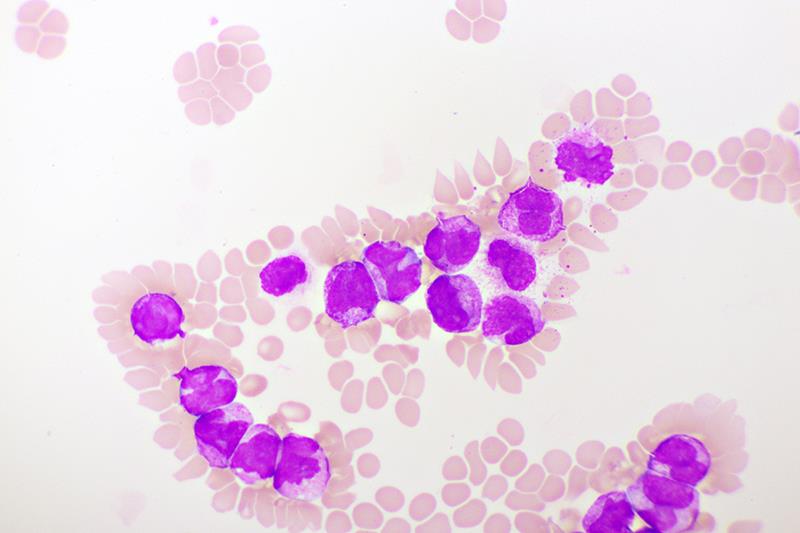
In children with newly diagnosed acute promyelocytic leukaemia (APL), the use of a chemotherapy-free treatment protocol is safe and efficacious, according to the early final results of the ICC-APL-02 study.
Among the 114 patients who received treatment in the study, the 2-year overall survival rates were 99.1 percent (95 percent confidence interval [CI], 93.9–99.9) overall, 100 percent in the standard-risk subgroup, and 97.4 percent in the high-risk subgroup over a median follow-up of 785 days, reported senior investigator Dr Franco Locatelli from IRCCS Bambino Gesù Children's Hospital in Rome, Italy. [EHA 2026, abstract S137]
The 2-year event free survival rates were 96.9 percent (95 percent CI, 90.4–99.0) overall, 98 percent in the standard-risk subgroup, and 94.3 percent in the high-risk subgroup.
“These outcomes are better than those reported in the ICC-APL-01 study, where paediatric APL patients were treated with a combination of all-trans retinoic acid and chemotherapy,” Locatelli noted.
The treatment protocol comprised all-trans retinoic acid and arsenic trioxide plus gemtuzumab ozogamicin. During induction treatment, arsenic trioxide was administered intravenously at 0.15 mg/kg/day, while all-trans retinoic acid was administered orally at 25 mg/m2/day. Treatment started at day 1 and continued until haematological complete remission was achieved. High-risk patients additionally received gemtuzumab ozogamicin on days 2 and 4.
During consolidation treatment, arsenic trioxide was given for 5 days weekly on a 4-weeks-on-and-4-weeks-off schedule for a total of 4 cycles. All-trans retinoic acid was given daily on a 2-weeks-on-and-2-weeks-off schedule for a total of 7 cycles. In high-risk patients only, triple intrathecal therapy was administered at the beginning of the first and third consolidation courses.
Well-tolerated
“Overall, treatment was well-tolerated,” without any suspected unexpected serious adverse reactions and permanent treatment withdrawal for intolerance, Locatelli said.
Common and known toxicities included pseudotumor cerebri differentiation syndrome, headache, and electrocardiogram – QTc prolongation.
There was one severe adverse event of myocarditis that was deemed related to gemtuzumab ozogamicin, but this complication resolved without sequelae, according to Locatelli.
One patient in the high-risk subgroup had a fatal intracranial haemorrhage, which occurred during induction treatment.
New standard of care
ICC-APL-02 is the first large, multicentre prospective trial delivering a non-chemotherapy-based treatment for children with newly diagnosed APL, Locatelli noted.
“We confirm that all-trans retinoic acid and arsenic trioxide are safe and highly effective in standard-risk patients. More importantly, the combination of all-trans retinoic acid and arsenic trioxide plus gemtuzumab ozogamicin has shown an excellent safety profile and unprecedented efficacy in high-risk patients,” he said.
“This study has now established the new standard of care for treating paediatric patients with de novo APL,” he added.
ICC-APL-02 study
ICC-APL-02 was conducted at 52 centres across Italy, France, Czech Republic, Netherlands, and Sweden. The population comprised 114 patients (median age 13 years, 53.5 percent male), of which 38 had high-risk APL and 76 had standard-risk APL.
Median duration of induction was 38 days, and 33.3 percent of patients had to stop treatment for a median of 5 days due to differentiation syndrome (41.2 percent), pseudotumor cerebri (12.3 percent), and prolongation of the QTc interval (11.4 percent).
Minimal residual disease (MRD) data showed that all but one patient achieved MRD negativity by the end of the third consolidation course. The single patient with MRD positivity had high-risk APL and remained MRD-positive after the end of treatment, only achieving molecular remission with two additional doses of gemtuzumab ozogamicin. This patient then underwent autologous hematopoietic stem cell transplantation and is alive and disease-free, according to Locatelli.
One patient with standard-risk APL had molecular relapse 1 year after completing the treatment protocol. This patient underwent a new treatment with all-trans retinoic acid and arsenic trioxide and is alive with MRD negativity.