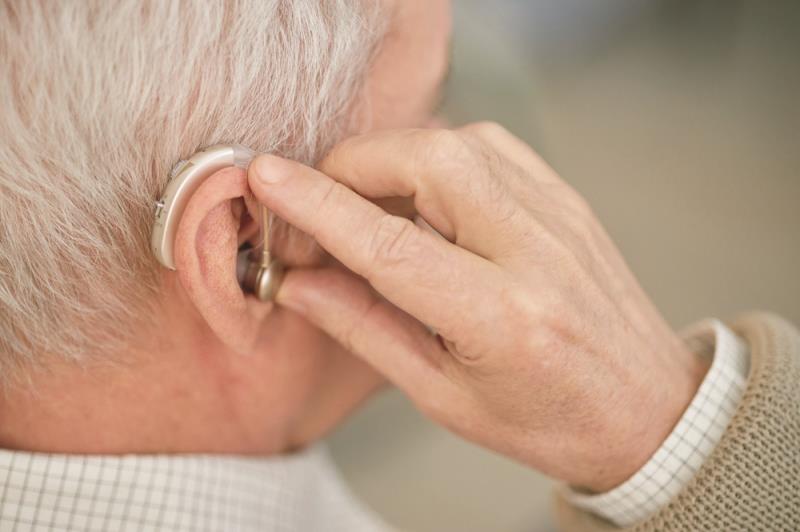
An analysis of longitudinal data from >60,000 individuals across 33 countries, conducted by a multinational team including researchers from the University of Hong Kong (HKU) and City University of Hong Kong, has found that effective use of hearing aids is associated with a lower risk of probable
dementia among older adults with hearing loss.
According to the 2024 Lancet Commission, hearing loss accounts for approximately 7 percent of dementia cases, which makes it one of the leading modifiable risk factors and implies that managing hearing loss is a significant public health priority in the context of minimizing dementia risk. [Lancet 2024;404:572-628]
“While hearing aids are widely regarded as the standard first-line treatment for adult hearing loss, their role in preventing cognitive decline has remained uncertain,” said one of the study authors, Professor Shanquan Chen, School of Public Health, HKU.
The study used harmonized longitudinal data from 61,089 hearing-impaired older (≥55 years) adults (mean age, 69.4 years; women, 49.4 percent) across seven cohorts spanning 33 countries to evaluate whether hearing aid use and its effectiveness are associated with lower risk of probable dementia. [Cell Rep Med 2026;7:102802]
At 15.4 percent, the baseline prevalence of hearing aid use was low. The adoption rates varied substantially across cohorts, ranging from 0.9 percent in China Health and Retirement Longitudinal Study (CHARLS) to 34.1 percent in The Irish Longitudinal Study on Aging (TILDA). Hearing aid use was markedly lower in middle-income vs high-income countries (2.6 vs 20.0 percent). Denmark had the highest adoption rate, while China had the lowest.
Overall, 63.5 percent of hearing aid users reported good device effectiveness, although this varied between cohorts, ranging from 21.6 percent in CHARLS to 81.0 percent in the Korean Longitudinal Study of Aging (KLOSA). High-income countries reported higher effectiveness than middle-income countries (64.4 vs 46.0 percent). Switzerland had the highest effectiveness ratings, whereas China had the lowest.
Over a mean follow-up of 6.5 years, 14.6 percent of participants developed probable dementia. In the pooled inverse probability of treatment weighted analysis, baseline hearing aid use was associated with a significantly lower risk of probable dementia vs no use (hazard ratio [HR], 0.91; 95 percent confidence interval [CI], 0.88–0.94).
Hearing aid effectiveness strongly influenced probable dementia risk. In the pooled analysis, participants who reported good hearing improvement with hearing aids had a 14 percent lower risk of probable dementia vs non-users (HR, 0.86; 95 percent CI, 0.80–0.93). However, hearing aid users who reported poor hearing improvement had no significant risk reduction, with risk essentially equivalent to the reference group of non-users. “Our study suggests that the benefit is not brought about by simply wearing a device, but depends on whether the device meaningfully improves hearing in daily life,” commented Chen.
In middle-income countries, hearing aid users vs non-users had an approximately 24 percent lower risk of probable dementia (HR, 0.76; 95 percent CI, 0.69–0.83), whereas this risk was approximately 8 percent lower in users vs non-users in high-income countries (HR, 0.92; 95 percent CI, 0.89–0.95). In cohort-specific analyses, the association reached statistical significance in the CHARLS, KLOSA, and the Mexican Health and Ageing Study (MHAS) cohorts.
“These findings have important implications for healthy ageing policies,” remarked Chen. “In high-income settings, the priority may be on fitting improvement, follow-up care and the long-term effectiveness of hearing aids. In middle-income settings, however, expanding affordable access to hearing care remains a major challenge.”