
Giới thiệu
PARKINSON’S DISEASE
 Parkinsons Disease and Dementia_Disease Background 1
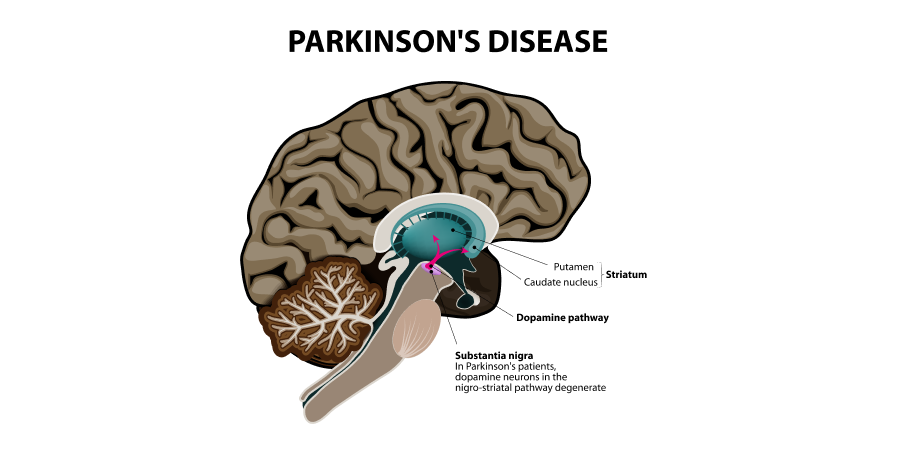
Parkinson’s disease is a common, age-related, chronic, progressive disorder caused by loss or degeneration of dopaminergic neurons in the substantia nigra of the midbrain.
PARKINSON’S DISEASE DEMENTIA (PDD)
Parkinson’s disease dementia indicates the loss of cognitive abilities, which may include memory, significant deterioration in the ability to carry out day-to-day activities, and changes in social behavior.
Dịch tễ học
There is an increased prevalence and incidence rate of Parkinson’s disease in the elderly. Men have a higher incidence rate, with a relative risk 1.5 times more than in women. Estimates of prevalence differ significantly by geographic region. Compared with Europe and North America, Parkinson’s disease is less prevalent in Africa (especially sub-Saharan Africa), like or less prevalent in Asia, and shows comparable rates in Latin America. A United States (US) study found that the incidence of Parkinson’s disease is higher among individuals of Hispanic ethnicity compared with non-Hispanic White, Black, or Asian populations.
For Parkinson’s disease dementia, an 8-year prospective study of patients with Parkinson’s disease revealed that approximately 78% of the representative Parkinson’s disease cohort developed dementia during the study period. Dementia occurs more commonly when akinesia and rigidity predominate over tremor.
Sinh lý bệnh
PARKINSON’S DISEASE
 Parkinsons Disease and Dementia_Disease Background 2
The pathologic hallmark of Parkinson’s disease is loss of dopaminergic substantia nigra neurons, with surviving neurons often containing a characteristic cytoplasmic inclusion body (Lewy body). The key molecular pathogenic mechanism of Parkinson’s disease is associated with the accumulation of abnormal α-synuclein aggregates in both the peripheral tissues and the brain, along with the propagation of this pathology throughout the brain. These changes are accompanied by immune activation, neuroinflammation, mitochondrial dysfunction, and alterations in lysosomal and endosomal function. The Braak hypothesis proposes that Parkinson’s pathology starts in the medulla oblongata and olfactory bulb; then moves upward into the midbrain and substantia nigra, which is typically when physical symptoms appear. Finally, the disease reaches the cerebral cortex in the most advanced phases.
PARKINSON’S DISEASE DEMENTIA (PDD)
The pathology of Parkinson’s disease dementia includes neurotransmitter deficiencies in dopamine (substantia nigra and ventral tegmental area), acetylcholine (nucleus basalis of Meynert), norepinephrine (locus ceruleus), and serotonin (raphe nuclei), as well as Lewy bodies in cortical and subcortical regions.
Yếu tố nguy cơ
PARKINSON’S DISEASE
Risk factors of Parkinson’s disease include older age, male gender, presence of genetic predisposition or variants associated with Parkinson’s disease, family history, environmental agents (eg pesticide exposure), lifestyle behavior (eg diet), comorbidities (eg diabetes mellitus), and physical factors (eg past traumatic brain injury).
PARKINSON’S DISEASE DEMENTIA (PDD)
Risk factors of Parkinson’s disease dementia include older age, age at onset of Parkinson’s disease ≥60 years old, long duration of disease, absence of a resting tremor (akinetic-rigid subtype), and presence of hallucinations or depression.